Search growth is easy to oversell. A line goes up, someone calls it a win, and the inconvenient parts of the data disappear.
We took the opposite approach with MD Cleaners NYC. Their Google Search Console export covers 166 days, from March 2 through August 14, 2026. It shows a business earning substantially more visibility than it had in its first month. It also shows a click-through-rate problem that still needs work.
Both things are true, and both matter.
The result in one sentence
Comparing equal 30-day windows, Google search impressions grew from 207 to 774, a 274% increase, while clicks grew from 5 to 15, a 200% increase. The calculated impression-weighted average position improved from 20.71 to 17.23, but CTR declined from 2.42% to 1.94% as the site appeared for a wider set of searches.
View the full interactive client report or download the PDF version.
What the Search Console data actually says
For the first 30-day window, March 2 through March 31, MD Cleaners recorded:
- 207 Google search impressions
- 5 organic search clicks
- 2.42% click-through rate
- 20.71 calculated impression-weighted average position
For the latest 30-day window in the export, July 16 through August 14, the site recorded:
- 774 Google search impressions
- 15 organic search clicks
- 1.94% click-through rate
- 17.23 calculated impression-weighted average position
That is 567 additional impressions and 10 additional clicks in an equal-length comparison. It is not a comparison between a short launch month and a full mature month. Each side contains exactly 30 days.
Across the entire available period, Google recorded 2,613 impressions and 51 clicks. The United States produced 50 of those clicks. Mobile generated 29 clicks from 964 impressions, a 3.01% CTR, while desktop generated 22 clicks from 1,639 impressions, a 1.34% CTR.
Why we are calling this search visibility, not “total visitors”
Google Search Console measures performance in Google Search. A click means someone clicked from a Google result to the website. It does not necessarily represent a unique person, and it does not include direct visits, social traffic, referral traffic or every other source.
The supplied export also does not tell us how many search visitors called, submitted a quote form or became customers. Those outcomes require analytics and conversion tracking.
So the accurate conclusion is: MD Cleaners is being shown more often in Google and earning more search clicks. The export does not support a revenue claim, and we will not invent one.
The monthly pattern is stronger than a single percentage
Monthly impressions moved from 207 in March to 241 in April, 465 in May, 657 in June and 640 in July. August recorded 403 impressions in only 14 reported days.
That partial August period averaged 28.8 impressions per day, the highest daily pace in the export. March averaged 6.9.
The website work happened in stages rather than as one magic switch. The project history shows canonical and domain cleanup in April, expanded FAQ and answer-oriented work in April and May, and additional organization and action schema in July. The visibility trend improved during the same broader period.
That timing is encouraging, but it is not a controlled experiment. Seasonality, competition, crawling, demand and Google's systems can all affect performance. Search Console alone cannot prove that one markup change caused the increase.
The queries showing the next opportunity
The most useful part of Search Console is not the victory lap. It is the list of searches where Google is already testing the site but users are not clicking yet.
Bulk and wholesale dry cleaning
“Bulk dry cleaning NYC” recorded 78 impressions at an average position of 13.85 with no clicks in the query export. “Wholesale dry cleaners” recorded 35 impressions at position 7.89 with no clicks.
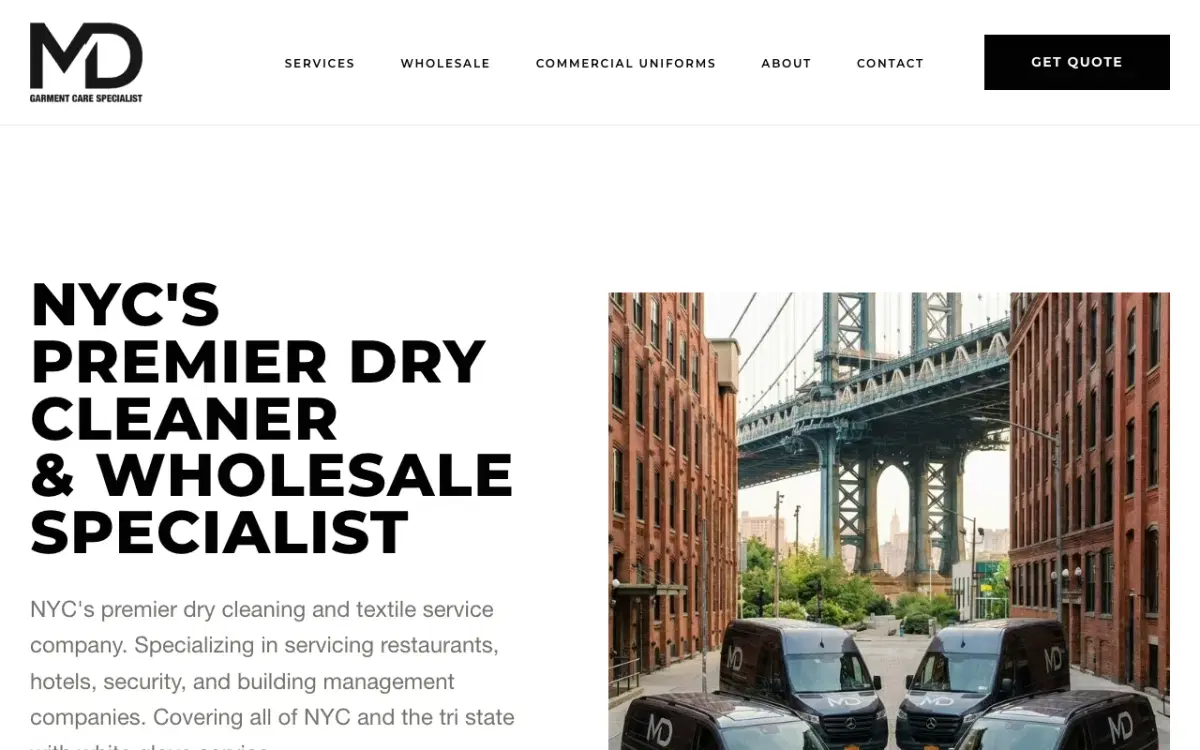
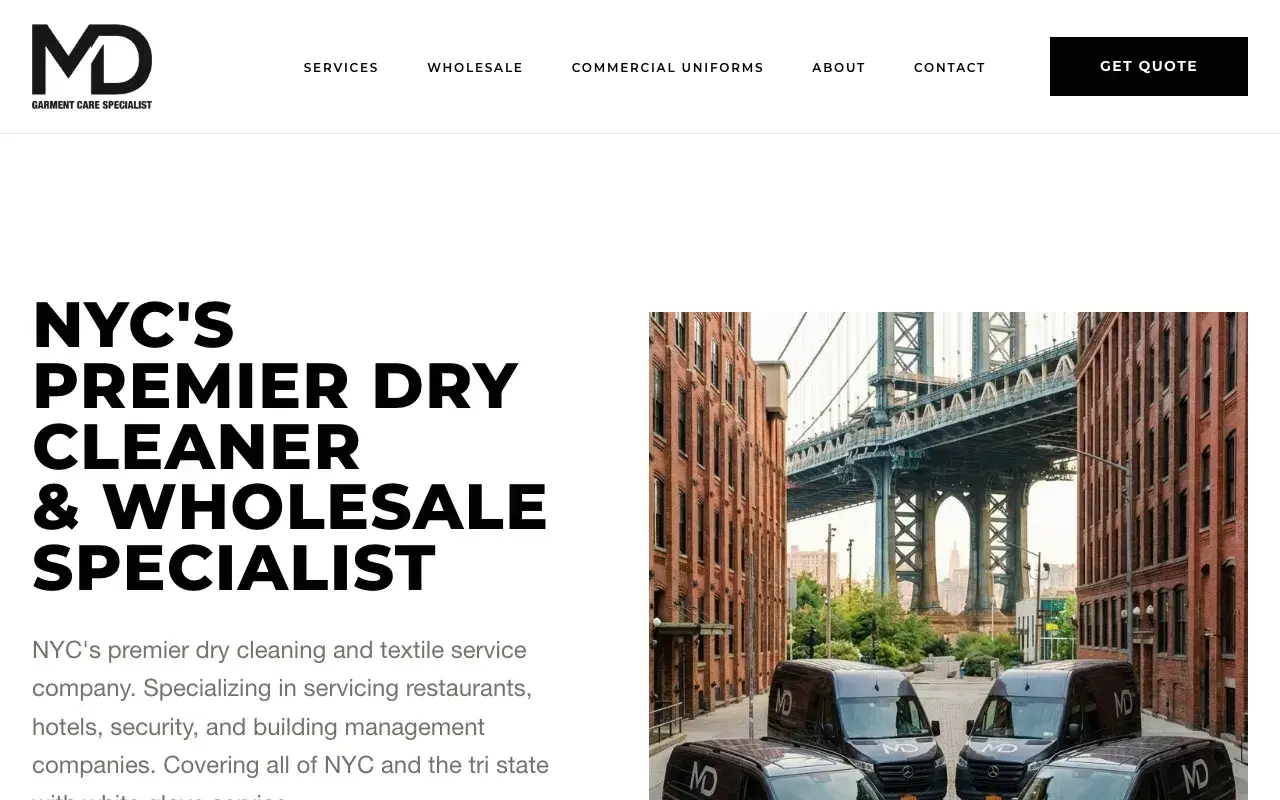
That tells us the homepage needs to define MD Cleaners as a commercial and wholesale provider immediately, in plain language. The updated page now opens with “Commercial & Wholesale Dry Cleaning in NYC,” while its existing hero description names scheduled pickup and the business types served.
Commercial uniform cleaning
“Uniform cleaning services” recorded 43 impressions at position 13.35. “Uniform cleaning service NYC” added 34 impressions at position 14.62.
The commercial uniform page was already relevant, but its language leaned on broad phrases such as “elite uniform programs.” The update makes the service explicit in the title, H1 and existing hero description: commercial uniform cleaning for hotel, security, concierge, restaurant and property teams.
Hotel express service
“Hotels with same day dry cleaning” was the highest-impression non-brand query in the export, with 89 impressions at position 35.64.
The wrong response would be to publish an unconditional same-day guarantee just to match the query. Service availability depends on garment type, volume, pickup time and route schedule. A new question in the page's existing FAQ now answers the intent directly and accurately: express or same-day work may be available, and MD Cleaners confirms each deadline case by case.
That is what answer-engine optimization should look like—useful, extractable and true.
The technical issue hiding inside the page data
Search Console listed both `.html` and extensionless versions of several service pages. For example, hotel-page impressions appeared under both `/luxury-hotels.html` and `/luxury-hotels`.
Duplicate access paths make reporting harder and can split search signals. Google's canonicalization documentation says redirects are a strong canonical signal, canonical tags are another strong signal, and sitemap inclusion provides additional support.
We added permanent redirects from extensionless duplicates to each preferred `.html` URL, kept self-referencing canonical tags, aligned internal URLs and refreshed the sitemap. After deployment, we will use Search Console URL Inspection to confirm which canonical Google selects.
What changed in the August SEO, AEO and GEO update
This release focuses on the gap between visibility and clicks:
1. Shorter, specific search titles. The homepage, uniform page and hotel page now lead with the service a customer is actually seeking. 2. Answer-first copy. Concise, visible explanations define the business, commercial uniform cleaning and hotel express availability. 3. Canonical consolidation. Netlify redirects support the preferred URLs already declared in canonical tags and the sitemap. 4. Structured-data alignment. WebPage descriptions and modification dates now match the content users can see. 5. Medical and property intent. The healthcare and property pages now name the exact service in their titles, H1s and existing hero descriptions, based on the query evidence. 6. Machine-readable reference. A concise `llms.txt` summarizes primary services and contact details. We treat this as supplemental documentation, not a ranking shortcut.
Google's current guidance for generative AI search is refreshingly direct: foundational SEO still applies, pages must be indexed and eligible for snippets, and there is no special markup required to appear in AI Overviews or AI Mode. The work is still to publish valuable content, make the business understandable and keep technical access clean.
The honest weakness: CTR has room to grow
CTR declined from 2.42% in the first window to 1.94% in the latest window. That is not unusual when a site starts appearing for more non-brand searches and lower positions, but “not unusual” is not the same as “good enough.”
The next measurement is whether the revised titles, descriptions and hotel FAQ answer earn more clicks from the visibility already available.
We will evaluate the hotel and uniform pages over the next 28 to 56 days. Rankings and snippets can take time to settle after recrawling, and Google may rewrite title links or descriptions when it believes another version better matches a query.
What we need to measure next
Search visibility is only the first layer. The next reporting cycle should connect it to business outcomes:
- Confirm GA4 events for quote submissions and tap-to-call actions.
- Add call tracking that preserves the public business number experience.
- Separate branded searches from service-intent searches.
- Monitor canonical consolidation in Search Console.
- Track service-page CTR and inquiries, not rankings alone.
If those systems show that more non-brand searchers become qualified calls and quote requests, we can move from a visibility case study to a revenue case study.
The takeaway for local service businesses
MD Cleaners did not need hundreds of generic blog posts. The site needed accurate service pages, clear business information, technical consistency and content built around real customer questions.
The data supports a high-confidence conclusion that visibility and search clicks improved over the available period. It supports a medium-confidence inference that the staged SEO, AEO and entity work contributed to that direction. It does not support a claim about leads or revenue yet.
That boundary is important. Good reporting should make the next decision easier, not make the last month look prettier.
Read the complete MD Cleaners performance report, download the client-ready PDF, or request an evidence-based visibility audit for your business.
Frequently Asked Questions
How much did MD Cleaners' Google visibility improve?In equal 30-day windows, impressions increased from 207 to 774, a 274% gain. Clicks increased from 5 to 15, a 200% gain. The available Search Console period runs from March 2 through August 14, 2026.
Does 51 Search Console clicks mean 51 unique visitors?No. Search Console reports clicks from Google search results. A click is not guaranteed to represent a unique person, and it does not include every traffic source.
Did SEO cause all of the growth?The timing is consistent with staged technical and content improvements, but the export is observational. It cannot isolate SEO work from seasonality, demand, competition or Google's own changes.
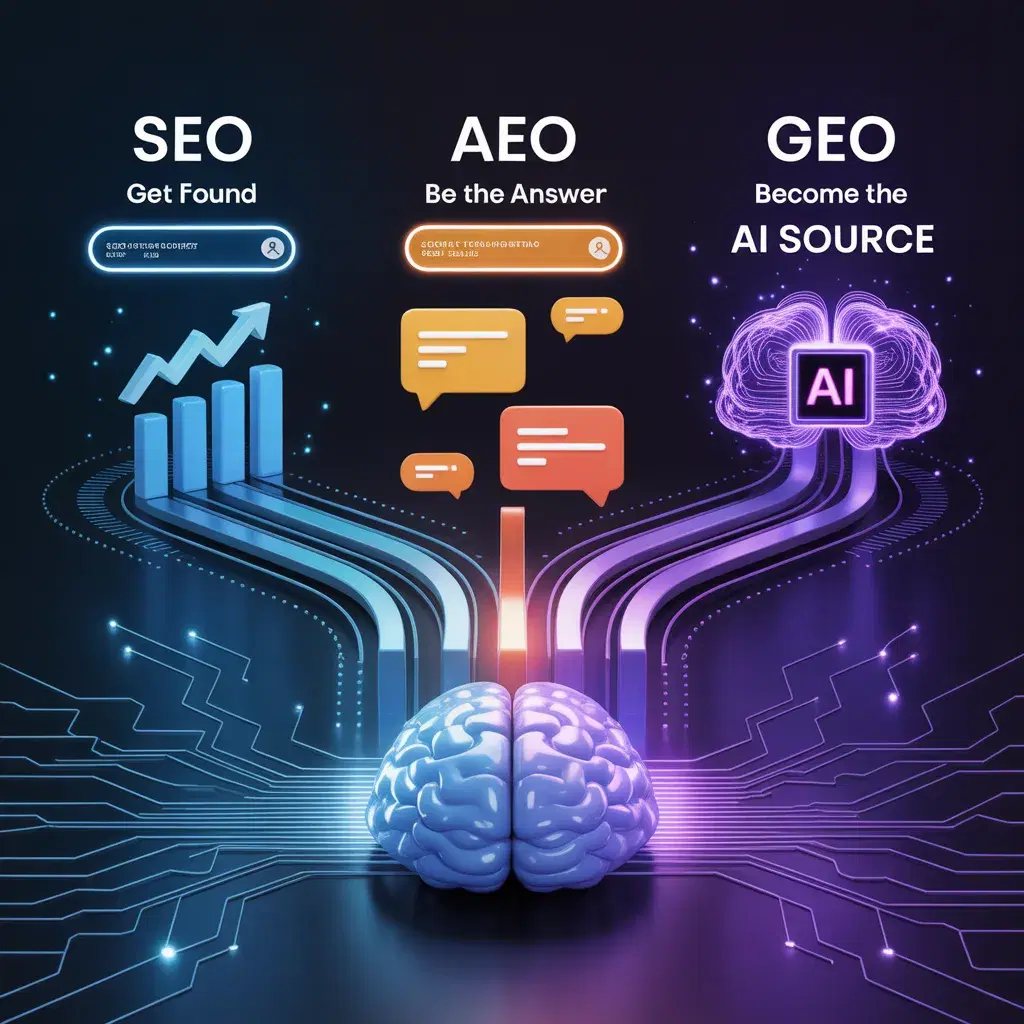
What are AEO and GEO in this case study?AEO means formatting useful answers so search and answer systems can understand them. GEO focuses on making entities, claims and source context clear enough for generative systems to retrieve and cite. Neither replaces foundational SEO.
Why did click-through rate decline while impressions grew?The site began appearing for a wider set of non-brand searches, often outside the top positions. That expansion can lower CTR. The current update targets this gap with more specific titles, descriptions and an accurate hotel FAQ answer.
Sources
- Google Search Console export supplied for mdcleanersnyc.com on August 16, 2026.
- Google Search Central: AI features and your website
- Google Search Central: Canonicalization
- Google Search Central: Specify a canonical URL
- MD Cleaners NYC