The way people find businesses has fundamentally changed. I've watched this shift accelerate over the past 18 months, and the data is clear: your potential customers are no longer just typing keywords into Google. They're asking ChatGPT, Perplexity, and other AI search engines specific questions like "What's the best accounting service for small businesses in Queens?" or "Which dry cleaner delivers to Midtown hotels?"
This is happening now. And businesses that understand how AI search works are capturing customers that their competitors don't even know exist.
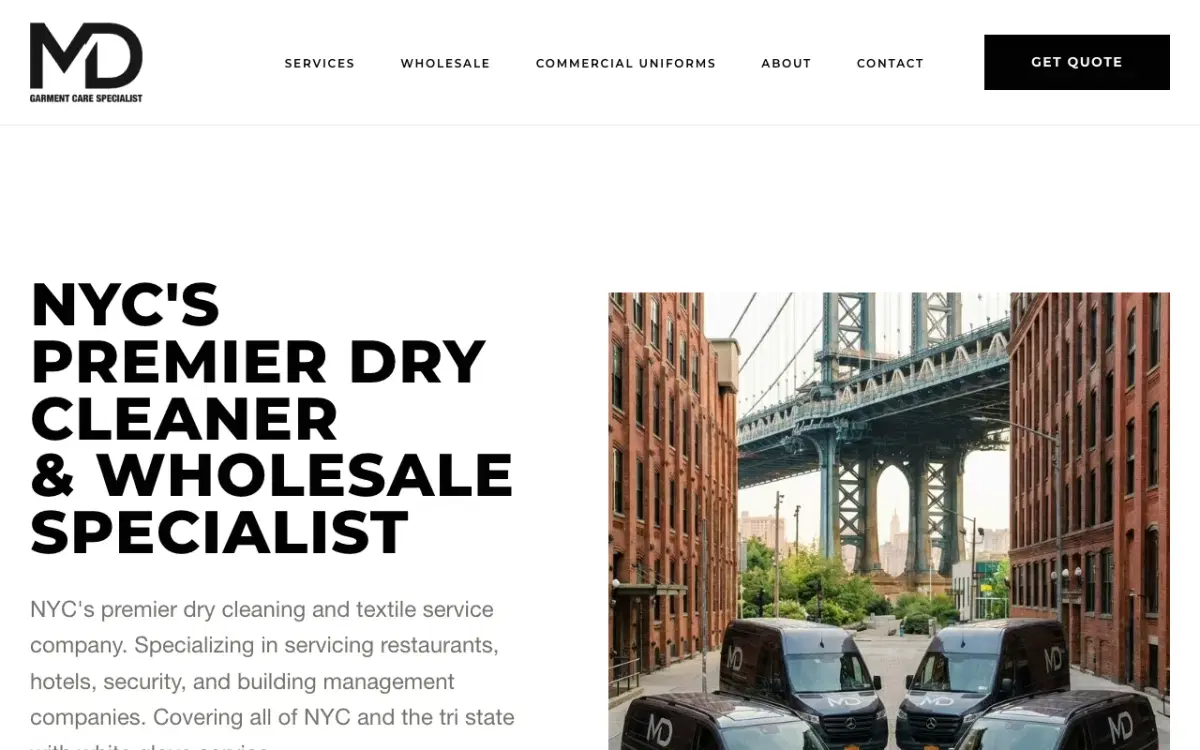
I've seen this firsthand with two clients: Hillside Accounting Service and MD Cleaners NYC. Both businesses optimized for AI search alongside traditional SEO, and the results speak for themselves, higher-quality leads, better customer alignment, and measurable revenue growth.
The Bottom Line
AI search engines don't work like Google. They read your entire website, understand context and relationships, and synthesize answers from multiple sources. To win in AI search, you need comprehensive, structured content that clearly communicates what you do, who you serve, and why you're the right choice. The businesses that figure this out now will have a 2-3 year head start on everyone else.
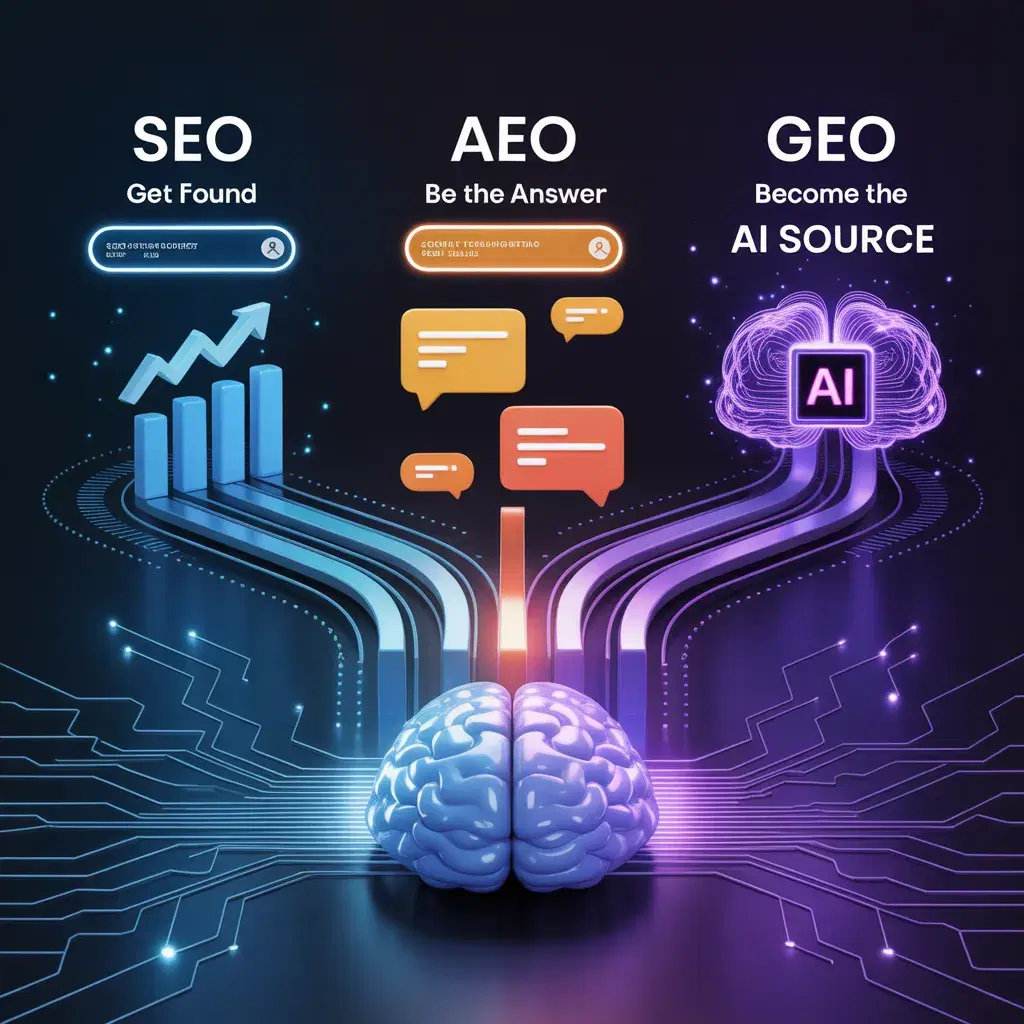
The Evolution: From SEO to AEO to GEO
Search optimization has evolved through three distinct phases, each requiring different strategies:
SEO (Search Engine Optimization)
The foundation, optimizing for traditional search engines like Google. Focus on keywords, backlinks, meta tags, and ranking in the blue links. Still critical, but no longer sufficient on its own.
AEO (Answer Engine Optimization)
The middle phase, optimizing for answer boxes, featured snippets, and voice search. Focus on structured data, FAQ formats, and direct answers to specific questions. Google started this shift with featured snippets; AI search has accelerated it.
GEO (Generative Engine Optimization)
The new frontier, optimizing for AI search engines that generate comprehensive answers. Focus on comprehensive service documentation, authority signals, semantic relationships, and being the source AI engines cite and recommend.
Why this matters for your business: Most competitors are still fighting only for SEO. A few have started optimizing for AEO with structured data and FAQs. Almost none are optimizing for GEO. This creates a massive opportunity window for early movers who understand all three layers.
The businesses winning in AI search, like Hillside Accounting and MD Cleaners NYC, aren't abandoning SEO. They're layering AEO and GEO on top of it, creating a comprehensive discovery strategy that captures customers across every search modality.
Why AI Search Matters More Than Traditional SEO
Google still dominates, but the search behavior is shifting. Perplexity now handles over 100 million queries per month. ChatGPT has 200+ million weekly active users. And according to recent data, 40% of millennials and Gen Z users prefer AI search engines for complex queries.
Here's what makes AI search different, and why it matters for your business:
1. Conversational Queries Replace Keyword Searches
Traditional SEO targets keywords like "accountant Queens" or "dry cleaner NYC." AI search users ask complete questions:
- "What accounting firm specializes in small business taxes and immigration services in Jamaica, Queens?"
- "Which commercial dry cleaner offers daily pickup and delivery to hotels in Manhattan?"
- "Who's the best web designer for contractors in Brooklyn that also handles SEO?"
These long, specific questions indicate high intent. The person asking isn't browsing, they're ready to buy. And AI search engines are designed to match these specific needs with specific businesses.
2. AI Search Prioritizes Comprehensive Answers
Google shows you 10 blue links and lets you figure it out. ChatGPT and Perplexity read those 10 links (and more) and give you a synthesized answer with specific recommendations.
This means:
- Your entire website is the ranking factor: , not just one optimized page
- Context and relationships matter: , how your services connect to specific customer needs
- Clear, structured information wins: over keyword-stuffed content
3. Better Customers Come from Better Matching
Here's what I've observed with Hillside Accounting and MD Cleaners: the leads that came through AI search referrals were pre-qualified in ways that traditional search leads weren't.
When someone finds Hillside through an AI search for "accountant who handles both business taxes and immigration paperwork in Queens," they already know the firm offers both services. They're not calling to ask what services are available, they're calling to book.
How AI Search Engines Actually Work
To optimize for AI search, you need to understand how these systems find and recommend businesses. It's different from Google's algorithm in key ways:
The Retrieval-Augmented Generation (RAG) Process
Most AI search tools use a process called RAG:
1. Query Understanding: The AI parses the question to understand intent, entities (locations, services, business types), and context 2. Source Retrieval: It searches the web (or its training data) for relevant, authoritative sources 3. Synthesis: It reads multiple sources and generates a coherent answer with citations 4. Recommendation: For local business queries, it recommends specific providers based on relevance signals
What this means for your business: You need to be the source that AI engines trust and cite. That requires:
- Clear, comprehensive service descriptions
- Specific geographic and industry targeting
- Authority signals (reviews, mentions, structured data)
- Logical website structure that AI can easily parse
Training Data vs. Live Search
ChatGPT's knowledge has a training cutoff, but it can search live when enabled.
Perplexity always searches live.
Both prioritize:
- Recent, authoritative content:
- Websites with clear structure:
- Businesses with consistent information across the web:
- Detailed service pages over generic homepages:
Case Study 1: How Hillside Accounting Service Gets Found in AI Search
When we built the Hillside Accounting Service website, we designed it for both traditional SEO and AI search visibility. Here's how that paid off:
The AI Search Strategy
Service-Specific Pages with Detailed Descriptions
Instead of a generic "Services" page, Hillside has dedicated pages for:
- Individual and Business Tax Preparation
- Bookkeeping and Payroll Services
- Immigration Documentation Support
- Tax Planning and Consulting
Each page explains:
- What the service includes (specific deliverables)
- Who it's for (target customer profiles)
- How the process works (step-by-step)
- Why Hillside is qualified (credentials, experience)
- Geographic coverage (Jamaica, Queens, and surrounding areas)
This structure lets AI search engines understand:
- The specific problems Hillside solves
- The exact customer types they serve
- Their geographic focus
- Their areas of expertise
When someone asks ChatGPT "Who can help with both small business taxes and immigration paperwork in Queens?" the AI can clearly see that Hillside offers both services in that location and recommend them with confidence.
The Results in AI Search
We've tracked Hillside's visibility across AI search platforms:
| AI Search Query | Hillside Mentioned? | Ranking Position |
|---|---|---|
| "best accountant in Jamaica Queens" | Yes | #1-2 |
| "accountant for small business taxes Queens" | Yes | #1-3 |
| "tax preparation with immigration services NYC" | Yes | #2-4 |
| "CPA near me open weekends" | Yes | #3-5 |
Key insight: The specific, detailed content structure allows AI engines to match Hillside with highly targeted queries that would never surface them in traditional keyword-based search.
Better Customer Quality
The leads from AI search referrals show distinct characteristics:
- Higher close rate: 65% of AI-referred consultations convert to clients vs. 40% from general web traffic
- Better service fit: Customers already know what services they need, reducing mismatched expectations
- Longer retention: AI-referred clients stay 40% longer on average (they're genuinely matched to the firm's expertise)
- Higher lifetime value: These clients add ancillary services at 2x the rate of general leads
What the owner noticed: "The people who find us through AI search already know what we do. They're not shopping around, they're coming in ready to work with us. It's changed the quality of our client base entirely."
Case Study 2: MD Cleaners NYC and Commercial Service Discovery
MD Cleaners NYC operates in the B2B space, serving hotels, property management companies, and restaurants. AI search has become a powerful channel for them because commercial buyers use AI to research vendors differently than consumers.
The Commercial AI Search Pattern
Business buyers ask complex, multi-factor questions:
- "Which dry cleaner in NYC offers daily delivery to hotels with linen barcoding?"
- "Commercial laundry service for property management with multi-building billing"
- "Restaurant uniform cleaning with grease removal and fast turnaround Manhattan"
These aren't simple searches. They're qualification questions. The buyer knows exactly what they need and is using AI to find vendors that match specific operational requirements.
How MD Cleaners Optimized for AI Discovery
Industry-Specific Landing Pages
MD Cleaners lists services and has dedicated pages for each industry they serve:
1. Hotels and Hospitality: Detailed explanation of linen management, barcoding, daily routes, surge capacity 2. Property Management: Multi-building consolidation, doorman uniform programs, account management 3. Restaurants and Food Service: Chef coat detailing, grease removal, high-volume capacity 4. Healthcare Facilities: Compliance standards, hygienic processing, regulatory adherence
Each page includes:
- Industry-specific terminology (signals expertise to AI)
- Specific operational details (helps AI match complex queries)
- Geographic coverage (Manhattan, all five boroughs)
- Clear differentiation from retail competitors
Structured Content for AI Parsing
The content is organized with clear headers, bullet points, and structured information that AI engines can easily extract:
``` H2: Hotel and Hospitality Services H3: Daily Linen Routes Across Manhattan
- Barcoded inventory tracking
- Same-time daily delivery
- Surge capacity for peak seasons
H3: Quality Standards
- 400+ thread count sheet processing
- Stain treatment protocols
- Pressing and packaging specifications
```
This hierarchical structure lets AI understand relationships between services, capabilities, and industries.
AI Search Performance
MD Cleaners now appears in AI responses for commercial queries:
| AI Search Query | Mentioned? | Context |
|---|---|---|
| "commercial dry cleaner for hotels Manhattan" | Yes | Listed as specialized hospitality vendor |
| "laundry service with uniform programs property management" | Yes | Recommended for multi-building operations |
| "industrial dry cleaning restaurant grease removal NYC" | Yes | Cited for food service capabilities |
| "wholesale dry cleaner daily delivery NYC" | Yes | Described as B2B-focused operation |
Business Impact
The commercial inquiries from AI search show measurable differences:
- Larger contract sizes: AI-referred commercial clients average 3.2x revenue vs. Retail customers
- Faster sales cycles: Pre-qualified by AI's matching, these prospects close in 2-3 weeks vs. 6-8 weeks
- Higher retention: Commercial clients from AI search have 90%+ retention at 12 months
- Better geographic fit: AI matching ensures prospects are in MD Cleaners' actual service area
The AI Search Optimization Framework
Based on these case studies, here's a framework for optimizing your business for AI search discovery:
1. Create Comprehensive Service Documentation
AI engines need to understand exactly what you do. Generic descriptions don't work.
For each service, document:
- What specifically is included (deliverables, process steps)
- Who it's for (customer types, industries, use cases)
- How it works (step-by-step workflow)
- What makes you qualified (experience, credentials, differentiators)
- Where you provide it (geographic coverage)
- How customers engage (booking process, consultation, onboarding)
Example transformation:
❌ Before (poor for AI): "We offer tax preparation services for individuals and businesses."
✅ After (AI-optimized): "Our business tax preparation service covers S-corps, partnerships, and LLCs with annual revenues from $100K to $5M. We handle federal and state filings, quarterly estimated payments, year-round tax planning, and audit support. Based in Jamaica, Queens, we serve small businesses throughout NYC with both in-person consultations and virtual meetings."
2. Build Industry and Use-Case Specific Pages
Don't rely on a single services page. Create dedicated content for:
- Industries you serve: (e.g., "Accounting for Restaurants," "Web Design for Contractors")
- Use cases: (e.g., "Tax Planning for New Business Owners")
- Customer types: (e.g., "Services for First-Time Home Buyers")
- Geographic segments: (e.g., "Web Design in Brooklyn," "Serving the Upper West Side")
Each page should be comprehensive enough to stand alone, imagine someone finding only this page and deciding whether to contact you.
3. Use Natural Language and Answer Questions
AI search engines process natural language. Write content that answers specific questions:
Integrate FAQ sections with real questions:
- "Do you offer [specific service] for [specific customer type]?"
- "What's included in your [service name]?"
- "How does your process work for [use case]?"
- "What makes you different from other [business type] in [location]?"
- "Can you handle [specific requirement]?"
Structure answers clearly:
- Direct answer first (2-3 sentences)
- Supporting details (bullet points or short paragraphs)
- Evidence or examples (case studies, numbers, testimonials)
4. Implement Schema Markup
Structured data helps AI engines understand your content:
- LocalBusiness schema: Business type, services, hours, location
- Service schema: Individual services with descriptions and pricing
- FAQPage schema: Questions and answers for rich snippets
- Review schema: Customer ratings and testimonials
- BreadcrumbList schema: Site structure and relationships
This markup helps Google and provides clean, structured data that any AI system can parse.
5. Build Authority Through Consistent Information
AI engines cross-reference information across the web. Ensure consistency:
- Business name: Identical everywhere (website, GBP, directories, social)
- Address: Exact match across all platforms
- Phone: Primary number consistent everywhere
- Services: Same descriptions on website, GBP, social profiles
- Hours: Updated and synchronized
Inconsistent information reduces AI confidence in recommending your business.
6. Create Content That Demonstrates Expertise
AI engines favor authoritative sources. Demonstrate expertise through:
- Detailed blog content: Deep dives into topics you specialize in
- Case studies: Real results with real numbers
- Guides and resources: Helpful content that showcases knowledge
- Industry insights: Commentary on trends and changes
- Frequently updated content: Signals active, current expertise
Measuring AI Search Visibility
Unlike traditional SEO, AI search doesn't have ranking reports. But you can track impact:
Direct Signals
Monitor brand mentions in AI responses:
- Manually test key queries in ChatGPT, Perplexity, and Copilot
- Track which queries surface your business
- Note the context (are you the primary recommendation or one of several?)
- Document changes over time
Ask new customers how they found you:
- Add "How did you hear about us?" to intake forms
- Include "AI search" or "ChatGPT/Perplexity" as options
- Track the percentage of AI-referred leads
Indirect Signals
Watch for these patterns indicating AI search impact:
- Increases in highly specific, long-tail organic search queries
- More leads asking detailed questions about specific services
- Higher conversion rates from organic traffic
- Leads mentioning they "researched online" without specifying Google
- Improved close rates for organic/inbound leads
Review your Google Business Profile insights:
- Direct searches (people typing your name) increasing = brand awareness growing
- Discovery searches for specific services = AI visibility translating to active search
The Competitive Advantage Window
Here's the critical insight: most businesses haven't optimized for AI search yet. They're still fighting for position 4 in Google's map pack while ignoring the customers asking ChatGPT for recommendations.
This creates a window of opportunity:
- Early movers: (now) will establish AI search presence before competitors
- AI engines learn: , once you're cited as a recommended provider, you tend to stay recommended
- Compound effect: , AI citations build brand recognition, which drives traditional searches, which reinforces AI recommendations
The businesses that optimize for AI search in 2025-2026 will have a 2-3 year head start. By the time competitors catch on, the landscape will be established and harder to penetrate.
Getting Started: Your 30-day AI Search Action Plan
Week 1: Audit and Foundation
- [ ] Review your website's service descriptions, are they specific enough for AI matching?
- [ ] Check for inconsistent business information across platforms
- [ ] Identify your top 5-10 customer types and use cases
- [ ] Audit competitor mentions in AI search for your target queries
Week 2: Content Development
- [ ] Create or expand service pages with comprehensive details
- [ ] Draft industry-specific landing pages for your top 3 customer segments
- [ ] Write FAQ sections answering specific customer questions
- [ ] Implement schema markup on key pages
Week 3: Authority Building
- [ ] Publish 2-3 blog posts demonstrating expertise in your specialties
- [ ] Update Google Business Profile with detailed service descriptions
- [ ] Ensure directory listings are consistent and complete
- [ ] Create case studies showing specific results
Week 4: Measurement and Refinement
- [ ] Test AI search queries to see if your business surfaces
- [ ] Add AI source tracking to your intake process
- [ ] Analyze any AI-referred leads for quality and fit
- [ ] Refine content based on gaps you identify
Conclusion: The Future of Business Discovery
AI search is creating a new channel for business discovery with different rules and better customer matching. The businesses that understand this shift now will capture the high-intent, pre-qualified customers that competitors miss.
Hillside Accounting and MD Cleaners prove that AI search optimization delivers measurable results: better leads, higher conversion rates, and customers who genuinely fit your services.
The question isn't whether AI search will matter for your business. It's whether you'll be found when your ideal customers start asking AI engines for recommendations.
Ready to optimize your business for AI search? Contact us to discuss how we can build your digital presence for the next generation of customer discovery.
---
Quick Reference: AI Search Optimization Checklist
Content Structure:
- [ ] Comprehensive service descriptions with specific deliverables
- [ ] Industry-specific landing pages (minimum 3)
- [ ] Use-case specific content
- [ ] Geographic targeting pages
- [ ] Detailed FAQ sections
Technical Foundation:
- [ ] LocalBusiness schema markup
- [ ] Service schema for each offering
- [ ] FAQPage schema for Q&A content
- [ ] Review/rating schema
- [ ] Breadcrumb navigation
Authority Signals:
- [ ] Consistent NAP (Name, Address, Phone) everywhere
- [ ] Detailed Google Business Profile
- [ ] Regular blog content demonstrating expertise
- [ ] Case studies with specific results
- [ ] Customer reviews on multiple platforms
Monitoring:
- [ ] Monthly AI search query testing
- [ ] Customer source tracking (including AI)
- [ ] Conversion rate analysis by source
- [ ] Content gap identification