ChatGPT has 800 million weekly users. Google AI Overviews appear in at least 16% of searches. Perplexity handles over 100 million queries a month.
When someone asks any of those engines "Who's the best [plumber / accountant / dentist] in [your city]?" your business is either in that answer or it's not. If you're not, one of your competitors is.
Here's what surprised us when we started tracking this for clients: the businesses winning in AI search aren't the ones with the biggest marketing budgets. They're the ones who made their business easy for AI engines to understand and trust.
This post covers what any business owner can do today without touching code, what professional services actually do under the hood, and why that work builds a brand reputation AI engines can't ignore. Plus a straightforward framework for deciding when to handle it yourself and when to call the experts.
---
What You Can Do Yourself (No Technical Skills Required)
You don't need to know what schema markup is or how to edit a robots.txt file. Start here.
Lock Down Your Business Information Everywhere
AI engines cross-reference your business name, address, and phone number across every platform they can find. If your website says "NYC Plumbing" but your Google Business Profile says "New York City Plumbing," the AI gets confused. Confused AI engines don't recommend businesses.
do this: Search for your business name on Google. Click every directory listing that comes up (Yelp, Yellow Pages, Nextdoor, Angi, BBB, any industry-specific directories). Make sure your name, address, and phone number are identical on every single one.
The Princeton GEO research paper found that consistent business information is one of the baseline signals AI engines check before citing a business. If they find inconsistencies, they move on to a competitor whose info lines up.
Add Real Questions and Answers to Your Website
AI engines love content that looks like a conversation between a customer and an expert. You don't need to write blog posts. You need to answer the questions customers actually ask you.
do this: Write down the 10 most common questions customers ask you every week. Add them to a Frequently Asked Questions section on your website. Answer each one in plain language, exactly the way you'd say it to a customer standing in front of you.
SEO.com's 2026 GEO trends report names this as one of the highest-leverage things a business can do. AI engines extract FAQ content disproportionately when assembling answers. It's structured, self-contained, easy to cite.
Make Sure Customers Can Review You Easily
Reviews serve two purposes. They convince human buyers to trust you, and they signal to AI engines that your business is active and reputable.
do this: After every completed job or service, send a text or email with a direct link to your Google review page. Don't ask, "Would you mind leaving a review?" Say, "If you're happy with our work, here's a direct link to leave a Google review, takes two minutes."
Google's Search Quality Rater Guidelines explicitly name review quantity and velocity as trust signals. AI engines from ChatGPT to Perplexity factor reviews into their citation decisions.
---
What Professional Services Do (And Why It Builds Brand Reputation)
The DIY steps above will get you on the board. But winning against competitors who are also doing them requires deeper work. This is where agencies like EnovaCreations come in.
Professional GEO (Generative Engine Optimization) services build a brand reputation AI engines trust through a few key areas.
Creating "Entity Clarity" AI Engines Can Parse
When an AI engine reads your website, it needs to understand exactly who you are, what you do, who you serve, and where you operate. Most business websites are vague. "We serve the tri-state area" doesn't help an AI figure out whether to recommend you to someone in Brooklyn.
The SEO + AEO + GEO Visibility service builds service pages structured so AI engines can extract the exact information they need. Each service gets its own page. Each page states the specific customer, the specific problem, and the specific geography. This is called entity clarity, and it is the single biggest technical factor in whether AI engines cite your business.
The Princeton GEO paper (arxiv 2311.09735) found that well-structured content with clear entities boosts AI citation probability by 30-40% compared to generic content.
How this builds brand reputation: When AI engines consistently cite your business for the right categories, it creates a feedback loop. More citations lead to more visibility. More visibility leads to more branded searches. More branded searches tell Google you're a recognized authority. Google rewards that with better rankings, which leads to even more AI citations.
Building the "Information Gain" That AI Engines Cite
AI engines don't want to cite the same generic advice every other website has. They want to cite something unique: a specific statistic, a real client result, an original observation.
EnovaCreations builds this into every client's digital presence. A plumbing client doesn't get a generic "about us" page. They get case studies with real numbers. "We reduced average response time from 4 hours to 45 minutes for a 12-unit Brooklyn apartment building" is something an AI engine will cite. "We provide fast service" is not.
Google has a published patent (US20210073303A1) on an Information Gain Score that measures whether a page adds something the rest of the internet doesn't have. The higher your Information Gain, the more likely Google and AI engines surface you.
How this builds brand reputation: Every time an AI engine cites your specific result or statistic, it trains the model to associate your brand with authority in your category. Over time, your business becomes the default answer for that type of query. New competitors have to displace an established citation pattern, which requires significantly higher effort.
Keeping Your Content Fresh (Which AI Engines Require)
AI engines have a strong recency bias. Perplexity explicitly timestamps every source it cites and avoids content older than 12 months. ChatGPT prefers sources less than 6 months old when browsing. Google's Query Deserves Freshness algorithm deprioritizes content that hasn't been updated in 90 days.
Our fresh content strategy guidelines document the mechanics. Every search and AI system has the same incentive: surface trustworthy, current information. Stale content signals neglect.
Professional services keep your digital presence on a refresh cadence. Service pages get updated with current pricing and offerings. Case studies get added as new clients come in. Blog content gets refreshed with current data. Your Google Business Profile gets updated with new photos and posts.
How this builds brand reputation: An actively maintained digital presence signals to both human buyers and AI engines that your business is operating, growing, and reliable. A website that was last updated in 2024 sends the opposite signal.
Driving the Citation Loop That Compounds Visibility
The most powerful thing professional GEO services do is start and maintain the citation loop. Your content gets optimized for AI citation, which leads AI engines to cite it in answers. Users click through from those answers, sending traffic and engagement signals to your site. Google interprets that engagement as a sign the content is valuable and ranks it higher. Higher rankings make AI engines even more likely to cite you. The loop feeds itself.
This compounding effect is documented in Search Engine Land's generative engine optimization guide. It's why early movers in GEO maintain their advantage. The first business to get consistently cited for a category builds a citation moat that competitors struggle to cross.
How this builds brand reputation: Your business appears everywhere a potential customer searches. In Google, in ChatGPT, in Perplexity, in AI Overviews. Each appearance reinforces the last. The customer sees your name three, four, five times before they ever contact you. By the time they call, they already trust you.
---
How Professional Optimization Increases User Search Visibility
When a professional service optimizes your digital presence for AI search, the impact shows up across the full discovery funnel.
Appearing in More Queries
Before optimization, a roofing contractor might rank for "roofer Brooklyn." After optimization, they appear for "commercial roofer with emergency response in Williamsburg," "roofing company that handles insurance claims in Brooklyn," and "flat roof repair for multi-family buildings in North Brooklyn."
AI engines match intent more precisely than keyword-based search. Each specific match is a new entry point for a potential customer.
Capturing the Full Funnel
Traditional search captures customers at the moment they search. AI search captures them earlier. A customer might ask ChatGPT "What should I look for when hiring a plumber?" The AI answer includes a checklist that mentions your business. The customer is in research mode. But when they're ready to buy, your name is already top of mind.
Our client Hillside Accounting saw this pattern clearly. After optimizing for AI search, 22% of new leads cited AI platforms as their discovery source. Those leads closed at a 65% rate versus 40% from general web traffic. They were further along in their buying decision before they ever contacted the business.
Owning the Branded Search Uplift
When AI engines mention your business but users don't click the citation, they remember your name and Google it later. This creates a rise in branded search traffic with no corresponding campaign. The traffic gets attributed to "organic search" in your analytics, but the AI engine started the journey.
This is the zero-click pattern most business owners miss. Professional GEO services track it, measure it, and optimize for it.
---
Should You DIY or Hire?
| Situation | Do it yourself | Call an agency |
|---|---|---|
| You have consistent NAP across directories | Done | Verify with a citation audit |
| You have a FAQ section on your site | Add 10 real customer questions | Expand with FAQ schema + question research |
| You're getting reviews regularly | Keep going | Build a review generation system |
| You have no dedicated service pages | Write clear descriptions for each service | Build comprehensive, AI-optimized service pages |
| You have no case studies | Write one client success story | Build a case study library with real numbers |
| Your site hasn't been updated in 6+ months | Start with the DIY steps above | Full digital presence refresh + GEO audit |
| Competitors are consistently appearing in AI answers for your queries | You need to catch up | Professional GEO optimization is your best move |
The businesses that win aren't the ones with the most technical knowledge. They're the ones who make their business easy for AI engines to understand, who maintain consistent and current information, and who build a digital presence that demonstrates real expertise.
You don't need to become a technical expert. You need to become the business AI engines trust. Those are two different things.
Contact us to learn how our SEO + AEO + GEO Visibility service can help you build the brand reputation AI engines cite and customers trust.
---
Frequently Asked Questions
How long does it take to see results from GEO optimization?Most businesses see initial AI mentions within 4-8 weeks if they have solid SEO foundations. Full citation loops and branded search uplift take 3-6 months. The Princeton GEO paper found that consistent optimization compounds over time.
Can I do GEO without changing my website?Not really. AI engines read your website content to decide whether to cite you. The DIY steps above (NAP consistency, FAQ, reviews) will help, but comprehensive results require structured content AI engines can parse.
Does GEO hurt my traditional Google rankings?No. Traditional SEO and GEO reinforce each other. The same signals that make you citable by AI (clear content, strong reviews, consistent information) also improve your Google rankings. The fresh content strategy that drives AI citations also triggers Google's freshness algorithms.
How do I know if GEO is working?If you're using a professional service, they'll track AI citation frequency, branded search volume, and referral traffic from AI platforms. If you're DIY, the single best metric is intake form results. Add "ChatGPT / AI search" as an option to your "How did you find us?" question and track it over 30 days.
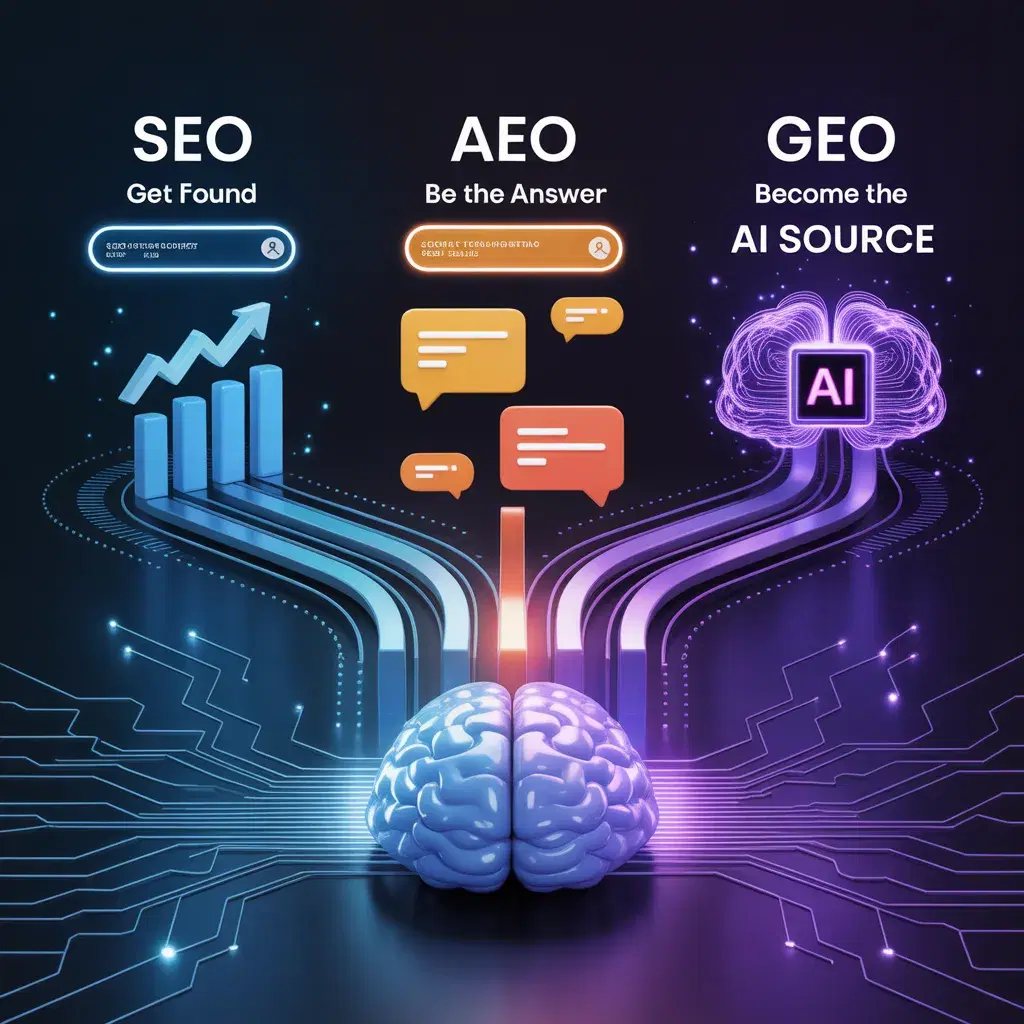
What's the difference between SEO, AEO, and GEO?SEO gets you in Google's blue links. AEO gets you in featured snippets and voice search answers. GEO gets you cited inside ChatGPT, Perplexity, Gemini, and Google AI Overviews. All three matter. SEO is the foundation, AEO is the snippet optimization, and GEO is the new frontier. Our full guide breaks down all three.